Team competitionBetween the bench and the market
Which city should host the Super Bowl?
HiMCM 2025, Team 16752 · The Village School · November 2025
Eight projects between the bench and the market
Bench experiments, devices, measurementsMarket prices, sourcing, portfolios
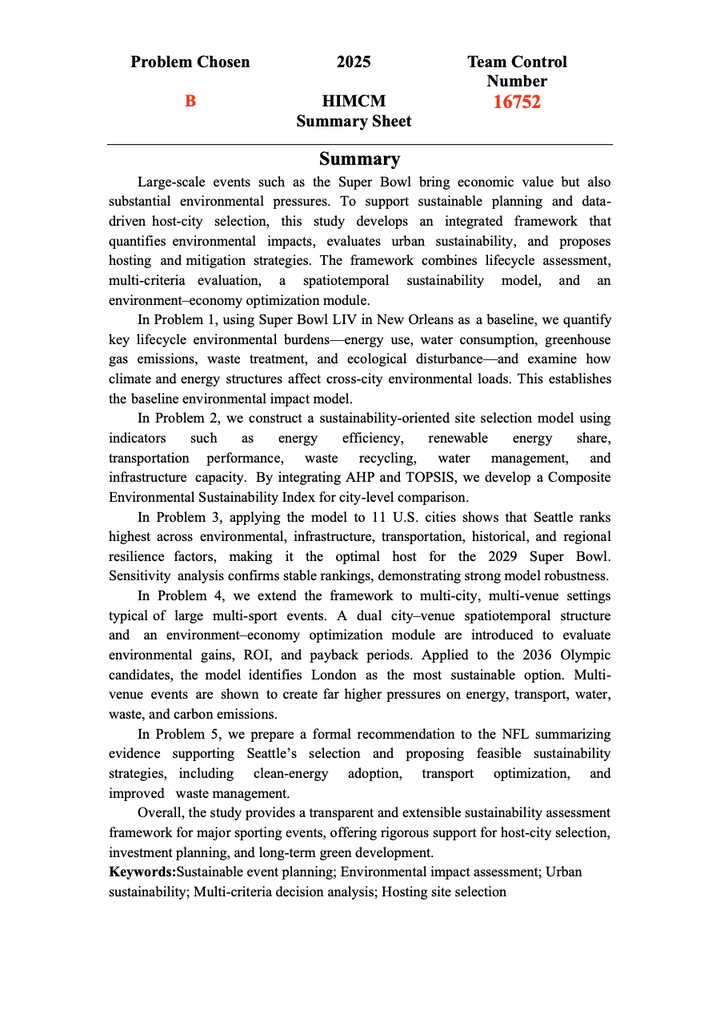
A major sporting event brings money to a city, and pressure on it: energy, water, emissions, waste, traffic. Host cities are often chosen on economic or political grounds. Our task in HiMCM 2025 was to build a model that puts the environmental side on the scale.
We used a New Orleans Super Bowl as the baseline, compared eleven U.S. cities for a future Super Bowl, then extended the framework to multi-venue events and the 2036 Olympic candidates.
The team’s work
- A lifecycle assessment of an event’s environmental burden, a city sustainability index built with AHP and TOPSIS, a spatiotemporal model, and an environment–economy optimization module.
- In the model, Seattle ranked highest among the 11 U.S. cities for the 2029 Super Bowl, London came out ahead among the 2036 Olympic candidates, and a sensitivity check left the ranking unchanged.
- Named a Finalist on Problem B: 48 of 1,091 teams from 498 schools in 24 countries and regions.
What I did
- Collected the data and ran the sensitivity analysis.
- Wrote equations, made figures, analyzed indicators and wrote sections of the paper.